
Clients creating a revocable living trust often ask whether signing the trust means they must begin filing an additional income tax return every year. For a typical Florida revocable living trust, the answer is usually no while the person who created the trust is living.
The reporting rules can change after the grantor's death, if the trust becomes irrevocable for another reason, or if the trust contains unusual tax provisions. Understanding that transition can help families prepare for future trust administration.
How Is a Revocable Living Trust Taxed During the Grantor's Lifetime?
A conventional revocable living trust is generally treated as a grantor trust for federal income tax purposes. The person who created the trust, known as the grantor or settlor, retains the right to amend or revoke it and is usually treated as the owner of its assets for income tax purposes.
As a result, the trust's interest, dividends, rents, capital gains, and other taxable items are generally reported on the grantor's individual federal income tax return, typically Form 1040. The income does not escape taxation merely because the underlying account or property has been transferred to the trust.
In the most common arrangement, the trust uses the grantor's Social Security number for tax reporting. Financial institutions may issue Forms 1099 under that number, and the grantor reports the income in the usual manner.
This means that creating and funding a typical revocable living trust does not normally add a separate annual trust return during the grantor's lifetime. It also does not, by itself, reduce the grantor's federal income tax.
Does the Trust Ever File Form 1041 While the Grantor Is
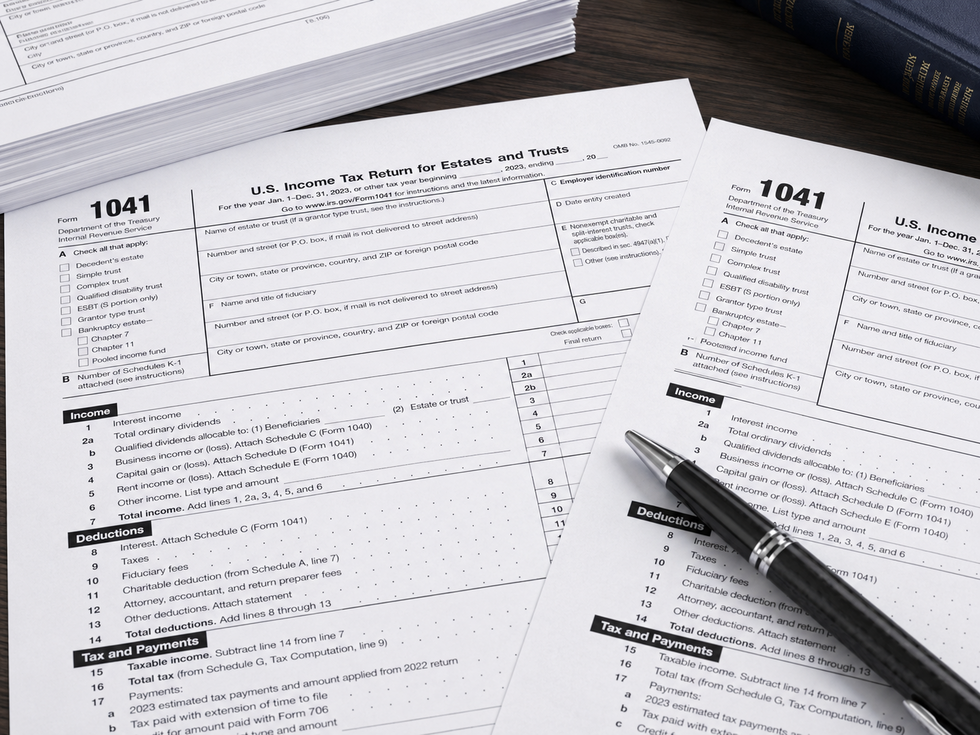
IRS FORM 1041 DOCUMENTS
Living?
Special circumstances can produce a different answer. A trust may involve multiple grantors, a grantor who is not a United States person, divided ownership, specialized assets, or terms that affect its classification.
Some grantor trusts also use alternative federal reporting methods. In limited situations, a Form 1041, U.S. Income Tax Return for Estates and Trusts may be submitted as an informational return even though the taxable items remain reportable by the grantor. The current IRS form expressly includes “grantor type trust” as an entity classification.
Accordingly, families should not assume that every document bearing the title “revocable trust” receives identical tax treatment. The trust agreement and actual ownership arrangement should be reviewed by the appropriate legal and tax professionals.
What Changes After the Grantor Dies?
A revocable living trust ordinarily becomes irrevocable when the grantor dies. At that point, the deceased grantor's Social Security number should no longer be used to report income earned by the trust after death.
The successor trustee will commonly need to obtain a separate Employer Identification Number for the trust and determine whether a federal fiduciary income tax return must be filed. Form 1041 reports a trust's income, deductions, gains, losses, distributions, and any resulting tax liability.
For a calendar-year trust required to file, Form 1041 is generally due on April 15 of the following year. Different deadlines may apply when an authorized fiscal year is used.
The deceased grantor's final Form 1040 and the trust's Form 1041 are separate returns. A probate estate, if one is opened, is also distinct from the trust and may require its own EIN and its own Form 1041.
Who Pays Tax on Income Distributed to Beneficiaries?
Responsibility for the tax depends partly on whether income is retained or distributed. A trust may receive an income distribution deduction for qualifying amounts distributed to beneficiaries. Beneficiaries may then receive a Schedule K-1 identifying the items they must report on their personal returns.
Not every payment from a trust is taxable income to a beneficiary. The character of the payment, the trust's accounting income, distributable net income, capital gains, expenses, and the terms of the trust all matter.
Can the Trust and Estate File Together?
In an appropriate post-death administration, the executor and trustee may consider a Section 645 election. Made using Form 8855, the election allows a qualified revocable trust to be treated as part of the related estate for federal income tax purposes during the election period. The election is irrevocable once made, so its advantages and administrative consequences should be evaluated carefully.
Practical Takeaways for Florida Families
- A typical revocable living trust does not file a separate income tax return while the grantor is living.
- Trust income is generally reported on the grantor's individual federal return.
- Funding a revocable trust does not automatically produce an income-tax reduction.
- After the grantor's death, the trust commonly needs its own EIN.
- A post-death trust may be required to file Form 1041.
- Beneficiaries may receive Schedule K-1 for reportable trust income.
- The trust, probate estate, and deceased grantor are separate taxpayers after death.
- Trustees should coordinate with an estate-planning attorney and qualified tax professional before filing.
At Gold Legacy Law, PLLC, I help individuals and families in Miami Lakes and surrounding South Florida communities create revocable living trusts and understand the steps involved in later trust administration. Addressing tax-reporting responsibilities early can help a successor trustee maintain organized records and avoid preventable complications.
Disclaimer: This article is provided for informational purposes only and does not constitute legal advice. Reading this content does not create an attorney-client relationship between you and Gold Legacy Law. For legal advice regarding your personal situation, please contact our office to schedule a consultation.

Comments
There are no comments for this post. Be the first and Add your Comment below.
Leave a Comment