
5 Common Mistakes With Do-It-Yourself Florida Wills
Do-it-yourself projects have become part of everyday life. With online forms, document-generating websites, and step-by-step instructions available for almost everything, it can be tempting to prepare your own Last Will and Testament to save time and money.
Unfortunately, a Florida Will is very different from a typical DIY project.
If you make a mistake during a home improvement project, you usually have an opportunity to fix it. With a Will, mistakes often are not discovered until after the person who signed it has died—when it may be too late to correct the problem.
As a Florida estate planning and probate attorney, I have seen families deal with the consequences of unclear language, improperly executed documents, poor beneficiary designations, and estate planning decisions that did not account for Florida's unique homestead laws.
Even a seemingly “simple” estate can involve complicated issues involving a spouse, children from a prior relationship, real estate, creditors, taxes, incapacity, or family dynamics.
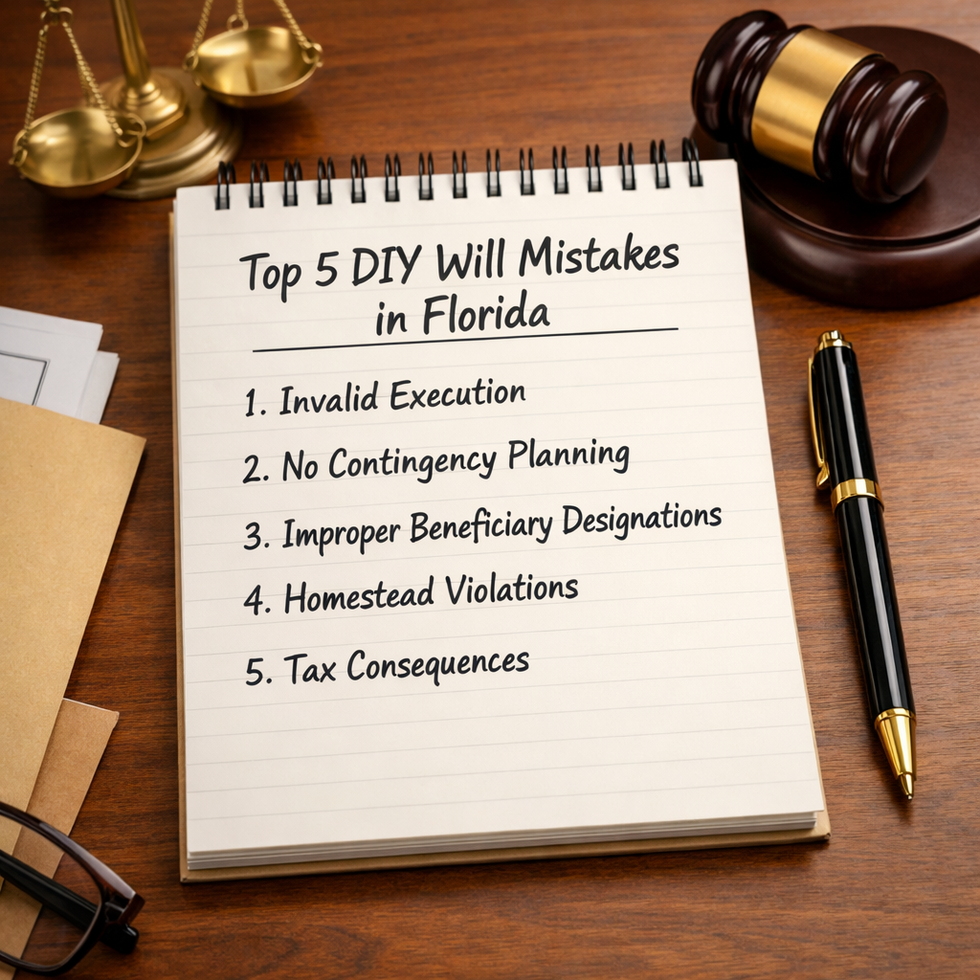
Below are five common mistakes people make when preparing do-it-yourself Wills in Florida, along with several related DIY estate planning strategies that can create unintended consequences.
1. Leaving Too Much With Too Little
Consider this example:
Jane has an estate worth approximately $500,000 when she prepares her Will. She leaves $100,000 to her alma mater as a specific gift and directs that the remainder of her estate be divided equally among her four children.
Years later, Jane dies with only $150,000 of probate assets.
Depending on the assets available, expenses of administration, creditor claims, taxes, and the language of the Will, the specific gift could dramatically reduce what remains for Jane's children.
Jane may never have intended that result.
Estate plans should be drafted with changing circumstances in mind. An experienced Florida Wills attorney can discuss whether gifts should be stated as fixed dollar amounts, percentages, residuary gifts, trust distributions, or another structure designed to better accomplish your goals.
2. Naming an Unqualified or Impractical Personal Representative
Your personal representative is responsible for administering your probate estate. This can include identifying assets, dealing with creditors, communicating with beneficiaries, working with attorneys and accountants, filing necessary documents with the probate court, and ultimately distributing estate assets.
Florida law establishes specific requirements regarding who may serve.
Under Florida Statute § 733.302, a qualified Florida resident may generally serve as personal representative if the person otherwise meets the statutory requirements.
A nonresident is not automatically disqualified, however. Florida Statute § 733.304 allows certain nonresident family members and relatives to serve.
This is one reason generic forms can cause problems. Someone may name a longtime friend, advisor, or other person who later turns out not to qualify under Florida law.
Legal qualification is also only part of the analysis.
You should consider whether the person you select is organized, trustworthy, financially responsible, capable of handling family conflict, and willing to take on the responsibility.
The right personal representative is not always the person you are closest to emotionally.
3. Failing to Properly Plan for Florida Homestead
Florida homestead law is one of the areas where DIY estate planning can become especially dangerous.
Florida provides significant protections for qualifying homestead property, and some protections may continue after the owner's death when the property passes to qualifying heirs.
However, what happens to homestead after death depends on several factors, including whether the owner was married, whether the owner had minor children, how the property was titled, and how the estate plan attempts to dispose of the property.
A seemingly harmless provision instructing the personal representative to sell all property and distribute cash can create issues that would not exist if protected homestead passed directly to appropriate beneficiaries.
Homestead should therefore be specifically considered when preparing a Florida estate plan rather than treated as just another estate asset.
This becomes even more important when an estate may have significant creditor claims.
4. Improperly Devising Florida Homestead
Florida also places restrictions on how homestead may be devised at death.
Under Florida Statute § 732.4015, Florida homestead generally cannot be devised if the owner is survived by a spouse or minor child, subject to an important exception permitting a devise to the spouse when there is no minor child.
When homestead is not validly devised, Florida law determines how the property passes.
For example, under Florida Statute § 732.401, certain circumstances involving a surviving spouse and descendants can result in the spouse receiving a life estate with the remainder passing to descendants. Florida law also provides the surviving spouse an election, in qualifying circumstances, to take an undivided one-half interest as a tenant in common instead.
These rules can become particularly important in blended families.
For example, someone in a second marriage may intend to leave a residence to a new spouse while also wanting children from a prior relationship to eventually inherit the property. A generic Will provision may not accomplish that objective.
Estate planning involving Florida homestead should be carefully coordinated with the client's marriage, children, ownership structure, and overall estate plan.
5. Improperly Executing the Will
A beautifully written Will is of little value if it is not properly executed.
A common DIY scenario looks something like this:
The person preparing the Will completes an online form, prints it, signs it at home, later asks one friend to sign as a witness, finds another witness on a different day, and eventually asks a notary to notarize the document.
That can create a serious problem.
Under Florida Statute § 732.502, Florida imposes specific execution requirements for Wills, including requirements concerning the testator's signature and two attesting witnesses.
Simply having two witness signatures somewhere on the document is not enough if the required execution formalities were not followed.
A notary also does not replace the required witnesses or cure an improperly executed Will.
Notarization is commonly used in connection with a self-proving affidavit, which can make probate administration easier, but it should not be confused with the legal requirements necessary to execute the Will itself.
This is one of the most significant risks of using a preprinted or online form: the document may contain the correct signature lines while providing little guidance about how the document must actually be signed.
DIY Estate Planning Mistakes Go Beyond the Will
Preparing your own Will is not the only DIY estate planning strategy that can create unexpected consequences.
Sometimes people try to avoid preparing an estate plan entirely by changing ownership of their property during their lifetime.
That can create even bigger problems.
Adding a Child to a Bank Account
A parent with several children may add one child to a bank account with the expectation that the child will divide the money among the siblings after the parent's death.
But the legal ownership of the account may not match the parent's informal instructions.
Depending on how the account is titled and the applicable banking documents, the surviving account holder may acquire rights to the money that conflict with what the parent intended.
Even in a close family, relying on a verbal promise can create unnecessary uncertainty and conflict.
Adding a Child to Your Home or Other Real Estate
Parents sometimes add an adult child to the deed to their home because they believe doing so will avoid probate.
Avoiding probate does not necessarily mean the strategy is a good one.
Transferring an ownership interest during your lifetime can expose that interest to issues involving the child's creditors, divorce, lawsuits, financial problems, or death.
For Florida homestead property, changing ownership can create additional complications involving constitutional and statutory homestead protections.
A deed should be part of a coordinated estate plan—not simply a shortcut to avoid probate.
Making Lifetime Gifts Without Considering Medicaid Planning
Transferring property to children can also affect future long-term-care planning.
Florida Medicaid rules generally examine certain transfers of assets made during the applicable look-back period. Transfers for less than fair market value can potentially result in a period of ineligibility for certain long-term-care Medicaid benefits.
This does not mean that a person can never make gifts.
It means that transferring a home, cash, or other significant assets solely because someone said “put everything in the kids' names” can create consequences that were never anticipated.
Estate planning and Medicaid planning should be coordinated when future long-term-care eligibility is a concern.
Losing a Potential Step-Up in Tax Basis
Taxes are another reason to be cautious before transferring appreciated assets during your lifetime.
When property is gifted during life, the recipient will often receive the donor's existing tax basis, subject to applicable federal tax rules.
By contrast, inherited property generally receives a basis determined by the property's fair market value at the owner's death, subject to exceptions and applicable tax rules.
Consider a simplified example:
Dad purchased a rental property many years ago for $40,000. It is now worth $300,000.
If Dad gives the property to his child during his lifetime, the child may receive Dad's existing basis rather than a new $300,000 basis.
If the property instead passes at Dad's death and qualifies for a basis adjustment, the child's basis may generally be determined using the property's value at death.
That difference can dramatically affect the capital gain recognized if the property is later sold.
Estate planning decisions involving appreciated real estate, investment accounts, or business interests should therefore be coordinated with appropriate tax advice.
Why an Online Form Cannot Replace Estate Planning Advice
The most important part of estate planning is not filling in blanks.
When I meet with a client, I want to understand the family.
Are there minor children?
Are there children from a prior marriage?
Does anyone have special needs?
Is a beneficiary financially irresponsible?
Could a beneficiary's divorce or creditors become an issue?
Does the client own a business?
Is there Florida homestead or other real estate?
Who can be trusted to handle money and make difficult decisions?
Is avoiding probate important?
Could long-term-care planning become necessary?
Are there assets that will pass outside the Will through beneficiary designations, joint ownership, or a trust?
Two families with the same net worth may need completely different estate plans.
That is why a computer questionnaire cannot always identify the legal and family issues that matter most.
A Will may ultimately be the correct solution. For another family, the better plan may involve a revocable living trust, beneficiary designations, powers of attorney, advance health care directives, special needs planning, carefully structured deeds, or a combination of strategies.
The document should follow the plan. The plan should not be dictated by whichever form happened to appear first in an online search.
Are DIY Wills Legal in Florida?
A Will does not become invalid merely because the person prepared it without an attorney.
The real question is whether the Will complies with Florida law and whether it actually accomplishes what the person intended.
A DIY Will can create problems because the person drafting it may not recognize an issue involving execution, homestead, beneficiaries, taxes, creditor protection, probate administration, or the legal effect of certain language.
Unfortunately, those problems often do not become apparent until after death.
Does a Florida Will Have to Be Notarized?
Notarization by itself is not what makes a traditional Florida Will valid.
Florida law generally requires the Will to comply with the execution requirements of Florida Statute § 732.502, including the applicable requirements involving the testator and two witnesses.
A Will may also include a self-proving affidavit that is notarized. A properly self-proved Will can simplify the probate process because additional proof from witnesses may not be necessary to establish the Will's execution.
The distinction is important: notarizing an improperly executed Will does not automatically make the Will valid.
Should I Use an Online Will in Florida?
Online estate planning tools may appear inexpensive and convenient, but the real cost of an estate plan should be measured by what happens when the documents are eventually needed.
An ambiguous provision, invalid Will, improper homestead devise, poorly selected personal representative, or unintended lifetime transfer can lead to probate litigation, additional attorneys' fees, tax consequences, creditor issues, and conflict among family members.
Sometimes the most expensive estate plan is the inexpensive one that has to be fixed after it is too late to ask the person what they intended.
Speak With a Miami Lakes Estate Planning Attorney
Estate planning is about much more than deciding who receives your property.
A properly designed plan should reflect your family, assets, goals, concerns, and the requirements of Florida law.
If you are considering preparing your own Will, using an online estate planning service, changing a deed, adding a child to an account, or reviewing an older estate plan, Gold Legacy Law can help you understand your options before decisions are made that may be difficult—or impossible—to undo.
Jacqueline Bowden Gold is a Florida attorney assisting clients with estate planning, probate, trust administration, and related matters.
To schedule a consultation with a Miami Lakes estate planning attorney, contact Gold Legacy Law, PLLC at (305) 556-5209 or [email protected].
Disclaimer: This article is provided for informational purposes only and does not constitute legal, tax, or financial advice. Reading this content does not create an attorney-client relationship between you and Gold Legacy Law, PLLC. Laws and individual circumstances vary. Consult a qualified professional regarding your specific situation.

Comments
There are no comments for this post. Be the first and Add your Comment below.
Leave a Comment